Drawing Academy X
The Drawing Process Part 1 — Paper and pencils
The actual work of drawing each issue was slow and painstaking. I worked on one panel at a time, following a kind of layered process (described below), completely finishing each one before moving onto the next one. Each panel took about two hours to do, on average. Even if I felt like I wa hurrying, it still somehow took two hours. Really large or detailed or complex panels could take two or three sessions to do, so maybe six or seven hours.
It's not always the panels that look the most dramatic or detailed that take the longest, though -- and some panels that you'd never think twice about have been the toughest to achieve. Often, a simple drawing of a character sitting there talking is rough work, just because of how difficult it is to put the right expression on the character's face, where a minuscule difference in a line length or width or placement changes everything.
Paper.
The paper I used was 11"x14" smooth surface bristol, which comes in pads of 20 sheets. For the most part, I drew two panels per sheet of bristol, which used up a lot of paper but got the best results. I have always had a fairly thick-handed style, and the best way to let my style be what it is and still get clean-looking lines is to draw the originals larger. For ACXeach original panel ended up being roughly nine inches wide and six inches high.
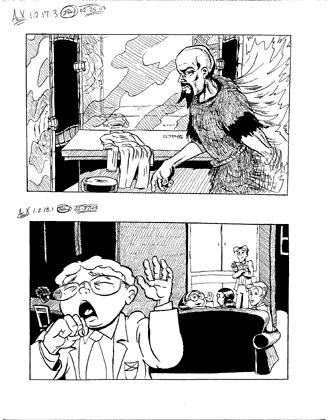
Fig 2a. An example of a finished bristol page. |
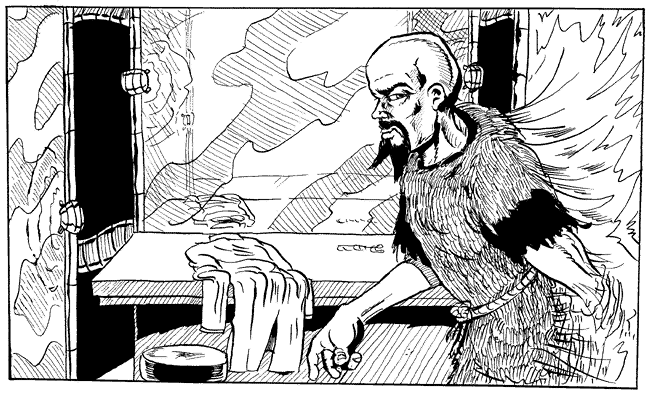 Fig 2b. A full-sized original panel. |
Pencils.
First, just for my own records, I jotted a note on the bristol that this was going to be volume W, issue X, page Y, and panel Z, and then the date. (I habitually date everything I work on, but it is often handy to have that reference later, even just to say, "Wow, it was all the way back in November 2002 that I worked on this.")
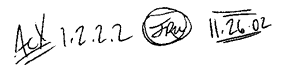 Fig 3. Example reference marker, signature, and date. |
Then I took a pencil and a ruler (a 15" straightedge with a cork backing, that you can find wherever drafting supplies are sold) and sketched out the panel borders. I drew each one differently, not according to a template, and I didn't pay attention to the exact dimensions. I just tried to get the right basic shape for the drawing that I was preparing to do.
It's important to keep a sharp pencil point when you're drawing. I find it enforces disciplined pencilling; when I let the lead go soft (and I could be really lazy about this, even though I know it is important), I tend to let my hand get looser, and my pencilling devolves from sharp details into muddy suggestions of possible placements. When I did this on ACX, it meant I had to make up a lot of the details on the fly as I was inking, because I neglected to render them at the pencilling stage. All of the best work I did resulted from making the pencils as sharp and detailed as possible. If the inking sometimes looked a bit rushed or sloppy, it was really the pencils that were at fault!
Some people recommend resharpening for every line you draw, which requires an electric sharpener, and I could not find a good one despite a lot of tries -- so by the end of the series, I had switched to using a mechanical pencil, so I could count on the point always being more or less sharp.
I try to draw from left to right, because otherwise my hand rests on the paper and smudges the pencils. I've had this problem since I was a little kid and first started drawing. My own hand would smudge out the work I'd been doing! For this series, I kept a napkin under my drawing hand, which helped a bit. As a general habit, I worked from top to bottom and right to left, so that my hand was always resting on a clean part of the page.
I drew the characters first, then backgrounds. For faces, the standard thing to do is to draw a circle with a vertical and a horizontal line through it, which gives you a rough idea of where the eyes go and where the vertical axis of the face is. Then you drop the jawline down from the basic circle and add the hair up at the top. Eyes actually tend to be close to the middle of the head, even though the tendency is to want to draw them at the top of the face. Starting with this basic crosshair helps you keep that straight. I used to resist doing this, but all of the friends I had who drew better than I did used this technique, so who was I to argue? The traces of this technique are a little faint in the examples below, but I think you can see what I mean.
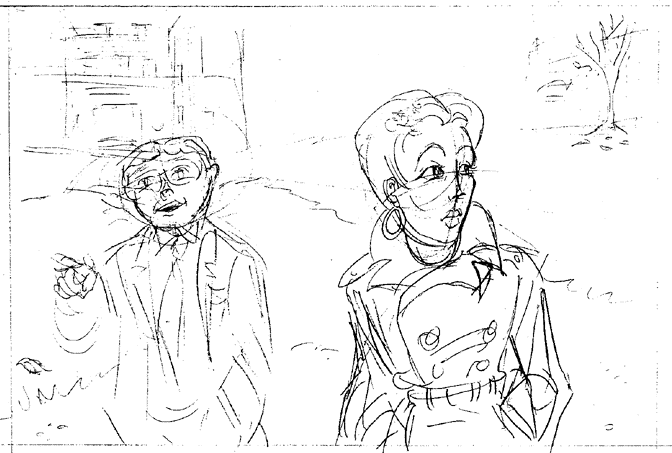 Fig 4a. The crosshair technique of drawing heads. |
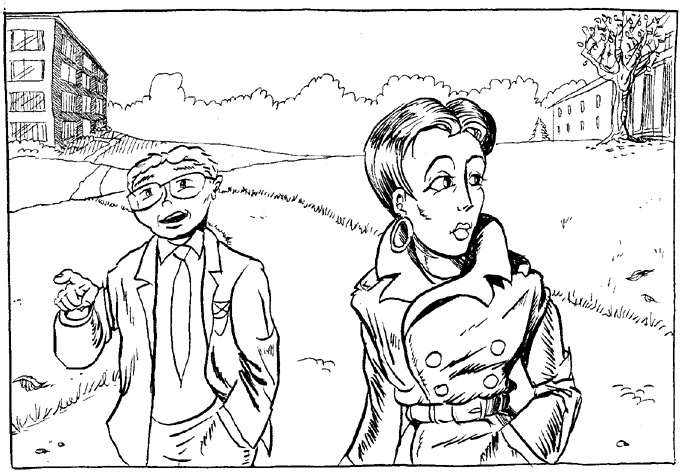 Fig 4b. The finished panel. |
After I worked out the characters, I penciled in the background. Drawing backgrounds is always fairly tedious business, and I was pretty lazy about it, although I got the job done. I've even gotten complimented on my backgrounds in ACX, which I find gratifying but bizarre. In the above example, the backgrounds are extremely sketchy. In the upper left corner is a dormitory that looks something like a castle. By the time I inked the panel, I decided that this was too complicated to do, and it ended up being a basically rectangular building with uniform windows. (This decision made my life much easier by the time I got to issue 3, and had to draw this same building in the background multiple times.)

Next: Inking