Drawing Academy X
Erasing.
It's sad to see the pencils go, because sometimes a few nice touches were in the pencils that didn't make it into the inks, but that's the way it goes. Before I erased the pencils, I often took another two-minute break. This would give me another rest for my hand, and a good opportunity to make sure the ink was dry on those panel borders before using the eraser, a a stupid mistake I've made more often than I want to admit.
Never use the little erasers that come on the ends of pencils. You will destroy your penciling, your paper, your ability to ink what's left, and your sanity.
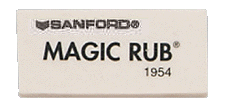
What you use instead is a special type of eraser sold in art stores, a kind that crumbles up as it lifts away graphite, but makes no abrasion in the surface of the paper whatsoever, even if you scrub at it like a bastard. (My heavy-handed pencils can sometimes not erase completely, which is why a lighter touch with a sharper pencil point is better in the long run.) The brand I used was Sanford's "Magic Rub." At any given time, I had a big supply of these erasers, a fairly good supply of spare 102 crow-quills, several extra bottles of ink, and a couple of extra pads of paper.
Finishes.
Second stage inking (or "finishes," as I called it in my own records) consisted of embellishments, solid blacks, and cleanup. Embellishments were activities like cross-hatching, thickening lines (often to increase the illusion of depth by making nearer objects have fatter strokes), making sure all of the lines that were near to the panel borders reached all the way to the panel borders, and even redrawing a small section of the picture. Sometimes my inking could be a little hasty or sketchy, and this is when I tried to correct some of that.
Solid blacks means taking a brush -- in my case, a Chinese calligraphy brush that I picked up in an art store -- and painting a medium to large area of the drawing with pure ink. There's no sense using a crow-quill to fill in a huge area, although I've been known to try it. The knack for where to place solid blacks in a comics panel is a distinct craft all its own. Solid black areas are important for adding depth, compositional balance, and expressive strength. Placing them is a craft I am still only just learning, and one that has not come naturally to me. I am aware of how helplessly random my solid blacks at times were in ACX, but that is because I was using the series as a chance to experiment, make mistakes, and learn.
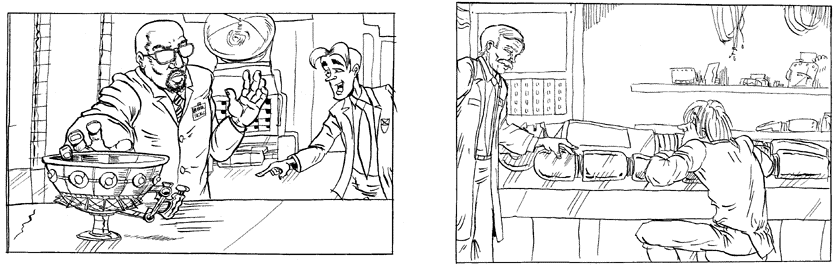 Fig 7a. Panels with completed first-stage inks. |
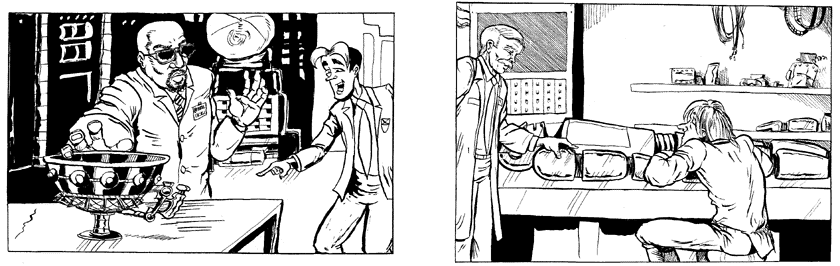 Fig 7b. The final panels, after the finishing stage. |
Once the solid blacks were in, the panel was basically done, but there were often still some sloppy bits. The panel corners never came out quite right, and usually some stray lines stuck out past the border lines. I used a white-out pen to clean these things up, as well as any other stray marks I saw. There are other, routine goofs that needed to go -- ink splatters and smudges, mainly.
The white-out pen is not a precision instrument, and was a bit tricky to use. As often as not, even being careful with it, I'd obliterate a bit of black I meant to keep. So, the last touching-up was often to restore the ink where I had accidentally whited it out. For those last touch-ups, I actually used a ballpoint pen instead of the crow-quill and ink. Why? It was just a little cleaner and easier. (However, not for everyone. I also have a lot more practice doing fairly detailed inking work with ballpoint pens, which most people don't.) Ballpoint ink isn't as dark as the india ink, though, so it didn't help for touching up spots of any length or size, just tiny spots.
With that, the panel is done! You can imagine why this tended to take two hours.
On a good day, I would get two panels done, but a lot of the time, I packed it in after just drawing one. The quality of my work suffered after a certain amount of energy was expended, and sometimes I purposefully stopped myself from working on another panel because I knew it will come out better if I came at it fresh the next morning.

Next: Post-production